Tuesday, June 26, 2007

The Best Policy

Remember what Thumper's mother taught? "If you don't have something nice to say, don't say anything at all."
Well FORGET what Momma Thumper said - did you hear what happened to her? It's true, she died in prison.

She started back in the 60's with mild antidepressants to deal with the inner pain and turmoil brought on by subduing her voice and true self. From there, she turned to harder and harder drugs like oxycotin, and finally got a prozac prescription which made her suicidal and crazy. She was in the slammer for 15 days (and about to get out on parole for good behavior) for erratic driving when an inmate accidentally stepped on her in the laundry. The end.

Momma Thumper meant well, of course. She wanted Thumper to be nice, and the only thing wrong with that is the damaging extremes "niceness" gets carried to. For many people, "nice" trumps EVERYTHING. If they were getting beat up, they might say "Please don't" rather than taking a swing back or throwing something.

You've heard names for the place where overly nice people wind up: pleaser, doormat, wimp, chicken, nothing. Zero. I like that word best because it describes the impact you can have on the world when unwilling to face any conflict.

Anyway, just because you didn't say it doesn't mean a thing or thought or feeling isn't there and isn't real. Denial doesn't just leave bad things unresolved and good things undeveloped, it drains you, damages your health, builds regrets, and wastes lives.

Go ahead and argue for these well-intentioned cowards who add so much sweetness to the world. I disagree. I see them passing their spineless behavior on to many others around them.

It's not that I don't appreciate their kind words, selfless service, and hot cookies, it's that they COULD HAVE BEEN sooo much more if they took that thoughtfulness and HIT THE WORLD OVER THE HEAD with it instead of timidly whispering it to whoever didn't mind listening. That would have been inspiring. That would have empowered people to stand up and be counted, to make a difference.

Anyway, kind words (and hot cookies) go down better from a strong personality who can deliver them with the force needed to imprint them deeply into your self image. See for yourself:
  • Example One: "Gee, you're really smart, just like everyone else I always say this to!"
  • Example Two: "Holy Cow, you're freaking brilliant!"
  • Example Three: "Yo! Eat these cookies for being such a genius. Don't share them with the morons."
Yes, I know this article is totally slanted and maybe goes too far and doesn't adequately explain all aspects of overly-nice people. Shut up. I'm making a point.

How did I develop such rich insight into the institutionally nice? Well, I spent a lot of my life being one of them. There, I said it. I'm not ashamed. I wasn't just nice because I didn't want to hurt people's feelings, either. It wasn't Thumper's mother's fault - I was, in some cases, simply afraid of what would come back at me if I stood up and said what I thought. I took the path of least resistance, and I'm sorry.

Here's a new message for the ridiculously nice: "Tell the truth." The real truth. The honest truth. You'll find it's the best policy.

I met a girl named Annie a few weeks ago, and while she sometimes offers a little apology for it, she speaks her mind. She tells it as she sees it. She says exactly what she wants. She points out what she thinks I should consider doing differently and muses briefly over any weaknesses she observes.

It doesn't come across as pushy or critical, which is probably because she won't be hurt if I don't take her advice and she's not worried about how I will react. She's not attached. I am me and she is she and while she may offer commentary, she doesn't try to control. I try to listen openly so as to not discourage her continued feedback.

Not only is her input frequently helpful, but talking with her is so refreshing! No games, no fear, no worry. In place of a blase' exchange of pleasantries, I get to experience a rich exchange of sometimes-challenging ideas and new perspectives. It's better than mere entertainment, it's learning, growth and expansion. Rather than just killing time, our conversations create lasting satisfaction and increased potential.

Honestly, it's so nice to hear what people really think and feel.

Wednesday, June 13, 2007

Mr. Fix It

One of my all-time favorite greeting cards starts out:
When life gives you lemons...
Then you open the card and read:
Say "#@$% these lemons!" and throw them back in Life's face.

That way Life learns not to mess with you.
What ever happened to making lemonade, you ask? Well, why make lemonade when I know there are sweet, juicy peaches available? Mmm, that's what I crave, so why settle for something else?

And that is my point: one of my biggest weaknesses is accepting my weaknesses.

I don't know how.

If I notice a tiny bulge building up around my middle, then it's time for a run. If I discover something that makes me uncomfortable, I set out to crush that discomfort. If I cross a limiting thought bouncing around inside my skull, I find a replacement and hammer it in place.

One of my all-time favorite compliments centered around this trait. A friend from Search and Rescue told me "You're not afraid of anything, and if you are, you run towards it!"

One of my all-time favorite people had a different take on it, however, when she told me "It's hard for people to connect with you when you don't show any weaknesses."

It's not that I didn't have weaknesses, and I'm certain that several of them showed through quite clearly, but I didn't accept them. I didn't see how they could possibly endear me to anyone. They seemed stupid and repulsive to me, and I tried to break them whenever possible.

If I couldn't do anything about weaknesses, then I'd probably learn a new approach to them, but the thing is, I can! I know how to change. Some changes are quick, some painfully slow. In this sense, I'm an eternal optimist, and I'm afraid that in the process of this perfectionism, my second friend may be right and I may turn more and more people away.

I was vaguely aware of this point, but has grown clearer since I began this blog a couple days ago. I'm all "this is the ultimate way to be" and then I read friends' blogs and notice that most of their very best, most inspiring work centers around weaknesses that they have come to accept. There's a poetry about it, a vulnerability, a warm humanness. People can connect to that and suddenly their lives are better understood and shared and that makes it all okay.

In contrast, I feel like a cold, demanding, inhuman monster. A relatively nice monster, but a demanding one nonetheless.

I recognize some of those words and traits. I remember my father who, whenever I showed him some accomplishment, wanting to celebrate it momentarily, often showed me how I could take it to the next level. Nothing was ever quite good enough. It's not that he wasn't proud of me, as he often said, but that wasn't the message that eventually sank in. By now, of course, our relationship is entirely different and he never says anything to indicate that my performance is sub par (or sub super), but the formative years are long gone.

I don't want to be like that and I think I'm quite good at taking a genuine interest in people's accomplishments. I love when people even try to excel. I don't always push.

So what do I do? I don't demand perfection, but I love excellence. I'm not yet satisfied with myself or my life, though I'm getting quite close.

The answer, of course, is both obvious and inevitable: fix this. Find a better way.

I can do that.

Tuesday, June 12, 2007

Do Your Duty: Follow Your Bliss

They sound contradictory, don't they? Duty and bliss? It's like saying "work vs. play" as if they're mutually exclusive.

Let's clear this up once and for all. All that crap your grandfather told you about doing your duty, about eating your bread by the sweat of your brow (and the implication that sweat is bad), about how work is not meant to be enjoyed...it's exactly that: doodie (as in doggy doo).

Yes, life does have an element of distasteful work and it's important to get the unpleasant tasks out of the way first so you can better enjoy the rest. Yes, the whole assertion used to be true even more than today. During the Great Depression and throughout the vast majority of world history, you had to work to survive and there's wasn't much room for being picky.

But times they is a-changin'. Opportunities abound. The world has a need for just about any talent you can name. Even science now supports the assertion that doing what you love is good for your success and even health.

Here's a quick review of my primary sources:

1. Hank Pfeffer worked for an aptitude testing company. The premise of the company is that when you match up an employee with a task that uses his/her natural abilities, they will perform better with less effort, stay on the job longer with less absenteeism, and be happier about the whole thing.

2. The company identified about twenty such aptitudes (or talents or knacks) such as seeing the big picture, remembering numbers, and manual dexterity. Most people have 3 or 4 such knacks.

But some people have twice that - 6 to 8. Hank wanted to study them but his boss wasn't interested, so he quit and did it on his own. You can read his fascinating results by googling "Too Many Aptitudes".

It turns out these extremely talented people rarely earned advanced degrees, climbed into positions of high authority within companies, or met with much success in life. Hank wanted to know why.

It turns out that talent is much, much more than just the ability to do something, it also causes the need to do them. If you don't use your talents, you will feel frustrated and unfulfilled. Such distraction can leave you dissatisfied with your current status or keep you jumping from ship to ship to ship trying to get your fix of each talent.

3. Now, Discover Your Strengths is a new book based on 30 years of research by the Gallup organization. It says a lot of the same stuff. It points out that using your talents can release endorphins that make your life feel more meaningful. It identifies 34 separate "talents" (which they define as any typical reaction that can be put to good use) which act as our filters - our way of seeing the world.

What all this should mean to you is that you practically have a duty to follow your bliss. Do what you love. Pursue your passions. In doing so, you will not only create more satisfaction and happiness in the world, you will inspire others to do the same, and chances are you'll be more successful.

Think of Jesus' Parable of the Talents. The master gave each servant some talents - to one, a single talent. To another, two. And to the third, five talents. He expected the servants to improve upon them while he was away. Yes, yes, in the parable, a "talent" was a piece of money, but I don't think that's what Jesus meant us to learn. Upon his return, only the servant with a single talent had not invested and improved his talent, to which the master said "Thou wicked and slothful servant" etc. etc.

So take account. What do you love doing? What are you good at, or might you become good at? The answers to these questions point you toward a piece of your life mission.

Now get to work, and have fun!

Because It's There

There are so many reasons to feel upset, dissatisfied, disquieted, put out, frustrated, impatient, unhappy...in short, any type of angst.

There's not enough money or time. There's too much work and toil. Not enough love and cheer. Too much sorrow and pain. Too much, too little, and that will never, ever change.

What to do?

Accept it. Love it. Celebrate it. Then get on with it.

I'm not giving this splendid advice because I discovered it or even know how to follow it well. But sometimes I succeed, and I'm telling you - it works!

Story problem time:

A. Billy's hot dog slides out of the bun on his first day of school. Now his favorite shirt is smeared with yellow and red mustard and ketchup stains. He scrunches up his face and begins to wail.

RESULTS: Billy becomes known as the sloppy crybaby. The name sticks until, near the end of his senior year of high school, the angst finally explodes and he goes on a one-man (initially) food fight riot in the cafeteria, throwing not only his own food but anyone's he can get his hands on impartially throughout the room. If that was the end of it, he would only have faced suspension for a few days, but having stolen an extra milk from the lunch line, he gets booked and the event goes on his permanent record.

OPTIONS: Billy could have chosen any number of other actions with varying results. He could have slipped into the bathroom and washed his shirt, more or less. He could have gone around hugging everyone and not been the only messy one in class. He could have turned in his shirt as the day's art project. He could have remained totally oblivious to the stain, replaced his hot dog, and continued on with his day.

B. April's job is killing her. She really wanted to be a neural surgeon, but her mother was a teacher, her grandmother was a teacher, and so on back for generations. The pressure of expectations was just too great. Now being surrounded by all these MINDLESS first graders is driving her bonkers!!!

RESULTS: April feels unhappy and unfulfilled.

OPTIONS: April could scream at the top of her lungs whenever it gets too bad. She could inform the kids that it's screaming time so no one hears her in the hallway. She could insult the children with 7th grade level words, and as long as she does it in a sweet voice, the kids may never know the difference. She could devise profound psychology experiments using the little rats...er, children as her subjects. Or she could just quit and pursue the career she wanted in the first place.

The point is that whatever is...is. There's NOTHING you can do about it but laugh! You CAN, however, do something about what WILL BE, and perhaps the best place to start is, once again, to laugh. If you're not going to make any changes to your unsatisfactory circumstances, then you'd really better laugh and make the most of it.

Leaving a party late one winter night in Logan, Utah (read "cooooold"), my car wouldn't start. The battery was dead. My friend Dallin and I pushed it for three blocks over a slippery, snowy road, unable to get enough traction to start the car, until we discovered a dry spot where the snowplows and salt trucks had passed. Before successfully jump starting the engine, with the below-zero air burning my lungs, I said "This sucks."

"No way!" Dallin immediately responded. "This is fun!" I felt ashamed for not having seen it that way in the first place.

Perspective. Acceptance. Celebration.

What is is. Might as well make the most of it.

We Are Snowflakes

In case you were wondering
from where we come,
of what we're made,
why we laugh, cry, or stare at the sky,
what makes the threads that keep us hanging on
for one more day;

We are biology.
Fibers and strands
cells and gaps
arteries, acids,
73% water.

In between the chemicals
we are desire,
love and fear
pleasure and pain,
hopes, dreams.

By day,
we are titles and schedules
a photograph, a signature
and a set of keys.
By night,
friends, lovers,
or the light in a lonely window
shining out over the city.

We live immersed in memory.
Unique beliefs about the world
about ourselves
about time and space,
steer us, pad reality.
Mythos: truth mixed together
with damning yet comfortable lies.

Maybe something left over
from before birth closed our eyes;
and potential,
buried deep beneath the skin,
ever invisible
always in shadows
affecting us more than we realize.

So alone in the universe,
So cut off from everyone and everything.
So hard to see clearly
All the way down
To the core;
but goose bumps come
now and again,
and we know
we are not alone.

Close your eyes and remember
on shady afternoons,
Feel Nature’s soft breath
bleeding through your veins.

We are the trees and the grass
Birds and bees
night and day
the light of the sun.

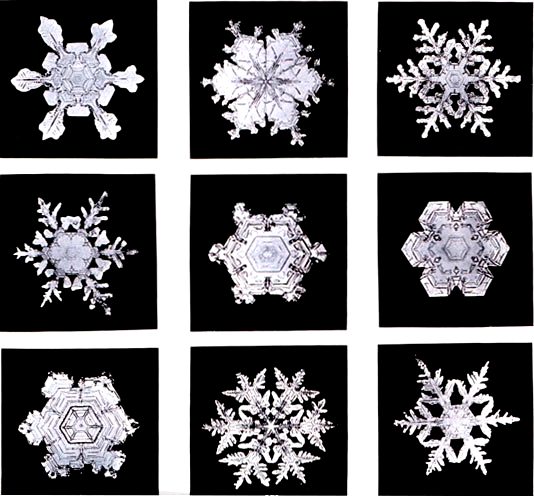
We are snowflakes -
intricate, beautiful, fleeting;
delicate, graceful, full of hidden meaning.
Cool on the tip of the tongue,
never two exactly alike.

Your Inner Art Gallery


Everybody makes such a big deal about snowflakes.

Maybe it's all that intricate detail, tiny white crystals creating sharp contrasts as the water molecules bond to one another.

Maybe it's the refreshing way they melt against your skin or in your mouth as you run back and forth in the storm like a fool, aiming your tongue at the biggest flake you can find in the falling sky.

Or maybe it's just as they say - that snowflakes are special because each one is unique in the universe.

Regardless of the cause for snowflake appeal, those little drops of water ain't got nothing on you.

No matter how little shows up on the surface, you are far more intricate, refreshing and unique than any snowflake. The only reason everyone doesn't go ga-ga every time you fall into a room is because no one knows how to see you.

But it's not hard. Here's how - try this with anyone who will agree to it:

1. Sit down facing each other.
2. Look into each others' eyes for at least three minutes.
3. No talking.
4. No looking away.
5. Blinking is okay.
6. Clear your mind.
7. Wait for a feeling to hit you.
8. Hold onto that feeling. Imagine what it looks or feels like. Wait for the words to arrive to explain it.
9. When the three (at least) minutes are up, share your impressions.

What you will discover is that the eyes are the window of the soul, the entranceway to everyone's inner art gallery. With practice, you'll learn to see and understand people more deeply than you thought possible. You'll learn to screen out your own imaginations and projections and trust your perceptions enough to overcome your doubts.

If this wasn't true, if you couldn't really see into someone just by looking, then why can eye contact be so intimate, so uncomfortable, so exciting or vulnerable or rude or frightening? If all you could see was the color of their irises, then eye contact would be none of those things.

Remember the movie Contact where the aliens tell Jodie Foster about how alone our species is as individuals? It doesn't have to be that way. When you get used to seeing people's insides along with the outside, you'll find connections like you've never imagined before. You'll discover how fascinatingly unique everyone is.

You'll even discover that our faults aren't so terrible after all - they're only protections or lessons we haven't yet learned. You will recognize that people are inherently good - though we often pile plenty of crap atop that goodness - and you will naturally turn that same charitable judgment upon your own flaws and shortcomings.

What are you waiting for? Whose art gallery will you peruse?

Snapshots

Sometimes I think of my life in terms of momentary snapshots - still frame vignette memories of people, places, events and feelings.

These pictures create the sensation of satisfaction and keep me going until my mental camera finds another worthwhile subject.

My current photos come from a motorcycle ride last weekend - flying down dirt roads stretching across the West Desert, cool wind blowing against my face through the open helmet, small herds of antelope bounding through green fields, the afternoon sun cutting the hills into thin slices by accentuating the rock strata like ribs on a sun-dried deer skeleton.

The mere fact that I experienced something beautiful somehow justifies my existence, the passage of time, and soothes the nagging awareness of all the dreams as-of-yet unrealized.

Those are the other snapshots - images invented in my imagination. Rather than filling me, they leave me aware of the emptiness caused by the space they are meant to fill - the person I am meant to be. Irrevocable successes at the end of long, dusty roads. Love that is shared and that endures.

At most, these empty images guide me into the future. They tell me what is worth pursuing, what is worth hoping and living for.

At the very least, they're wallpaper decorating the chambers of my mind, contributing thoughts and feelings to the story of my life.

Whenever possible, I seek new subjects for my mental camera and cover the imaginary, empty images with brilliantly saturated snapshots of reality.

Monday, June 11, 2007

How to Make the Ordinary Extraordinary

If not for one summer, I wouldn't love my sister Nicole nearly as much as I do.

We grew up mostly missing each others' lives for one reason or another. When I was in junior high, she walked around the house and sang off key and it drove me crazy. In high school, I was rarely home, always out with friends. Before graduating from college I had spent two years in Spain and nine months in China. Our parents divorced and we lived in different homes. She moved to France for nine months the same day I returned to the Orient for six, then she graduated and moved to Colorado. If not for one summer, our paths would never have crossed closely enough to leave a lasting impression.

That summer, we moved to San Francisco with our older brother who would begin law school at Berkley in the fall. He later moved out and left us alone in our Market Street studio apartment.

For most of the day, we worked in the city - Nicole at a deli near the Civic Center and me at a moving company or a gimmicky tourist store on the pier. At night, though, and on our days off, we often rode my motorcycle through town, around the Embarcadero, through the heavy mist that condensed against our helmet visors, up and down the steep streets. We went to the park or the beach or the Golden Gate Bridge and ran across to Marin County, the ocean sprawling far below. We talked and cooked and went to church and woke up to 5.4 earthquakes rolling our beds like surfboards, our apartment surging up and down, back and forth like a passing ocean swell.

Somewhere in between all that I learned how much I love my sister. She is bright and interesting and curious and good natured. She sees the world from many perspectives and shares them clearly and insightfully. She laughs easily, asks good questions, confides openly and keeps secrets faithfully. Her presence naturally, automatically makes it clear that you are not alone and it matters.

It makes me sad to think how near I came to never knowing my little sister.

And I see that sometimes the more commonplace something becomes, the more well-known and ordinary and familiar, the deeper your love for it grows. The more it becomes a part of your life and yourself.

Sometimes the exotic, the mysterious and the unknown left to discover proves itself far less precious than the known, the normal, the dependable - the exquisite, extraordinary ordinary.

The Volcano Next Door

My sister Nicole called from Las Vegas this evening. She moved to Colorado a dozen years ago, married an Air Force Academy cadet, then left for assignments in England, Hawaii, Alabama, D.C. and El Salvador before moving back within driving distance.

We chatted briefly about riding motorcycles at the family reunion this year and she told me a story about learning to ride on the volcano next to their place in El Salvador. She seemed to barely notice the fact that she was riding on a VOLCANO - and THAT is the point of this entire blog: one person's ordinary is everyone else's exotic. Is there any escape from our ordinary hum drum existence when the exotic becomes ordinary the moment we get used to it?

I quit my job late this spring and bought a one-way ticket to Aruba. My friend picked me up in the sailboat he just bought in Venezuela and we left for the Panama Canal. While waiting for our passage date, we spent a week in the San Blas islands, fishing, swimming around coral reefs, and teaching children living on a 50-yard-wide island how to play hop scotch using a course scratched into the white sand and a piece of coral as the hoppy tah.

Ordinary or exotic? It depends on who you ask.

After five weeks, having left the islands and spent days on end with nothing but the endless blue ocean for a horizon, nowhere to go beyond the 53' confines of the boat, I found my cell phone one day and it transported me to a reality I had begun to forget. I no longer took for granted the ability to step out the front door and go for an evening walk, hop in the car and drive down to the supermarket, or call a friend and go to a movie. The romantic dream of sailing thousands of miles across the oceans was becoming a stifling, restless nightmare.

As a rule, man's a fool
When it's hot, he wants it cool.
When it's cool, he wants it hot,
Always wanting what is not.
- Nat King Cole

The solution? Unacceptable answers include accepting a hum drum life with nothing beautiful or interesting or refreshing enough to make you care that you're still alive. You must either discover the extraordinary in the commonplace or make a habit of trying something new.

Easier said than done - life's routines have a way of taking up all your time and energy and making you forget all else. The exotic all around you becomes ordinary and you forget to notice its appeal. Days and weeks and years pass by and when old friends ask "What's new?" you only shrug and answer "Same old same old."

Easier said than done, but I will try.